
Ask a CTO in Toronto what they’re actually shopping for right now, and “chatbot” almost never comes up anymore. What they want is something that finishes the job: reads the ticket, checks the order status, updates the record, and only pings a human when something looks off.
That’s the shift behind the sudden interest in hiring an agentic AI development company. It’s happening fast across Toronto, Vancouver, and Montreal alike.
Gartner expects spending on agentic AI to more than double in 2026 versus last year. Canada is well positioned to catch a good share of that, thanks to research hubs like the Vector Institute, Mila, and Amii feeding a steady pipeline of AI talent into the market.
This guide is for anyone trying to sort real agentic AI development from a rebranded chatbot before they sign a contract. We’ll cover:
- What agentic AI actually is
- How it’s different from a chatbot or a generic generative AI tool
- What it costs in Canada
- How long a build takes
- What questions separate a serious partner from a vendor with a nice deck
That includes where Softfix Technologies fits into the picture.
What Is Agentic AI, and How Is It Different From Generative AI?
Generative AI writes things. Give it a prompt, and get back a paragraph, an image, or a snippet of code. It’s reactive by design; it sits there until you ask for something, hands it over, and stops.
Agentic AI doesn’t stop. Autonomous AI agents built this way can break a goal into steps, call outside tools and APIs, check their own output, and keep going until the task is actually done.
You give it an objective, not just a prompt. A quick way to picture the gap:
| Capability | Generative AI | Agentic AI |
| Core function | Produces content on request | Completes tasks and workflows |
| Interaction style | One prompt, one response | Plans, executes, and self-corrects across multiple steps |
| Tool use | Limited or none | Actively calls APIs, databases, and business software |
| Autonomy | Needs a human prompt for every action | Operates independently within defined guardrails |
| Example | Drafting a customer email | Reading the inbox, drafting the reply, updating the CRM, escalating anything unusual |
Generative AI is the engine. Agentic AI is what’s actually driving.
Most agentic systems in production today still run on an LLM under the hood. But they’ve been given memory, planning logic, and tool access, so they behave more like a junior employee than a text generator.
Why This Distinction Actually Matters
If all you need is content, marketing copy, summaries, product descriptions, generative AI on its own is probably enough.
But the moment you need something to act, you’re in agentic AI territory:
- Processing an invoice end to end
- Closing out a support ticket without a human touching it
- Reconciling two systems that don’t talk to each other
- Managing a multi-step approval workflow
A chatbot wrapper won’t get you there, no matter how well it’s prompted.
What Does an Agentic AI Development Company Do?
An agentic AI development company builds autonomous agents and wires them into the systems a business already runs on. It’s a lot more than prompt engineering.
In practice, this usually covers:
- Discovery work to identify which processes are high-volume and repetitive enough to justify automating
- Agent architecture and orchestration, deciding how one agent hands off work to another, a process known as multi-agent orchestration
- Framework selection, often LangChain and CrewAI, or LangGraph, depending on workflow complexity
- AI agent integration with CRMs and ERPs like Salesforce, HubSpot, SAP, or Microsoft Dynamics
- Retrieval-augmented generation (RAG), so agents ground their answers in your actual documents instead of guessing
- Governance and human-in-the-loop controls, including audit trails and approval checkpoints
- Ongoing monitoring, since agent performance drifts as your data and processes change
What Agentic AI Development Services in Canada Usually Look Like
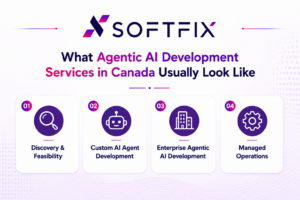
Most engagements fall into a handful of buckets:
- Discovery and feasibility: a scoped assessment before anyone commits to a full build
- Custom AI agent development: one agent, or a small team, built for a specific job like support triage or sales ops
- Enterprise agentic AI development: bigger deployments spanning departments, with heavier compliance involved
- Managed operations: the ongoing monitoring and retraining after launch that most vendors quietly leave out of the original quote
Agentic AI vs AI Chatbot vs Traditional Automation (RPA)
This comparison comes up constantly with Canadian buyers, so it’s worth being precise about it.
What Is the Difference Between an AI Agent and an AI Chatbot?
A chatbot talks. It answers questions, follows a script, and generally stops right before an actual action would need to happen. That’s where it hands off to a human or a form.
An AI agent is built for outcomes, not conversation. It can chat, sure, but it can also open a ticket, run a calculation, or fire off a workflow, then verify the action worked before deciding what to do next.
A chatbot tells the customer, “Your order shipped.” An agent notices the order is late, issues a partial credit within policy, and flags the exception for someone to review.
Can Agentic AI Replace Traditional Automation and RPA?
Not really, and any honest vendor will say so before you sign anything.
- RPA works best for rigid, repetitive tasks where the steps never change, like moving data from Field A to Field B, over and over
- Agentic AI earns its keep on messier work: judgement calls, unstructured inputs, and exceptions that don’t fit a fixed script
Most serious production-grade AI deployments in 2026 use both together. RPA handles the predictable backbone of a process; agentic AI sits on top and handles whatever doesn’t fit the rules.
Treating agentic AI as a wholesale replacement for automation, rather than a layer on top of it, is one of the more common mistakes businesses make when scoping a first project.
How Do AI Agents Integrate With Existing Business Systems?
This is usually where a project succeeds or quietly stalls. It’s a good gauge of whether a vendor knows what they’re doing.
Integration generally comes down to a few pieces working together:
- API connections into Salesforce, HubSpot, NetSuite, SAP, or Dynamics, so agents can read and write records directly
- A middleware or orchestration layer that translates an agent’s intent, like “update this customer’s address,” into the correct API call, with validation before anything writes back
- Event-driven triggers, so an agent kicks in automatically the moment a new lead or invoice lands
- RAG pipelines tied to internal documents, so responses stay grounded in your actual policies
- Human-in-the-loop checkpoints for anything touching money or customer communication
One step gets skipped more often than it should: a data readiness audit before any of this is built.
If your CRM data is a mess, the agent built on top of it will be too. It’s the single most common reason pilots stall before reaching production.
How Much Does Agentic AI Development Cost in Canada?
This is probably the most-searched question around agentic AI development company pricing in Canada. The honest answer is that it swings widely depending on scope.
Here’s a realistic range based on current market rates for custom builds, not off-the-shelf. SaaS subscriptions:
| Type of System | Typical Cost Range |
| Single-purpose AI agent (e.g., support ticket triage) | $15,000 – $60,000 |
| CRM/ERP-integrated AI agent with tool use | $50,000 – $150,000 |
| Multi-agent orchestration system (cross-department) | $150,000 – $400,000+ |
| Enterprise-grade system with full compliance and MLOps | $250,000 – $1,000,000+ |
A few things move a quote up or down:
- How many systems it needs to connect to
- How clean your data already is
- Whether the industry has compliance requirements attached
- How much autonomy the agent gets before a human signs off
- Whether managed operations are bundled in or billed separately later
Worth mentioning to your accountant: custom AI agent development often qualifies for Scientific Research and Experimental Development (SR&ED) tax credits. That can knock a meaningful chunk off the effective cost, depending on your province and how the work is documented.
How Long Does It Take to Build a Custom AI Agent for My Business?
A single agent tied into one or two systems usually takes 6 to 12 weeks from discovery to a working pilot.
A full multi-agent rollout across departments can run 4 to 9 months, especially with deep ERP work or a formal compliance review in the middle of it.
If a vendor gives you a firm timeline before doing any discovery, that’s worth questioning. Accurate timelines depend on how ready your data is, and nobody knows that until they’ve actually looked.
Is Agentic AI Safe and Compliant Under Canadian Privacy Law?
Every serious buyer asks this eventually, and it deserves a straight answer.
Canada currently regulates AI-related data handling mainly through:
- PIPEDA: the existing federal privacy law covering how personal information gets collected, used, and shared
- Quebec’s Law 25: a stricter provincial law covering anyone handling the personal data of Quebec residents, including rights around automated decision-making
- OSFI guidance: for federally regulated financial institutions specifically
Here’s something a lot of vendor blogs get wrong, so it’s worth stating plainly. The Artificial Intelligence and Data Act (AIDA), meant to become Canada’s first dedicated federal AI law under Bill C-27, died when Parliament was prorogued in January 2025. It never passed.
Canada doesn’t currently have a standalone federal AI statute. New legislation is widely expected to be reintroduced at some point, and the government’s voluntary Code of Conduct for generative AI is still a decent benchmark in the meantime.
What that means practically: agentic AI is entirely legal to build and deploy in Canada today.
Any agentic AI consulting firm worth hiring will still build as though stricter federal rules were coming anyway, with audit trails, human oversight on high-impact decisions, and documented risk assessments baked in. That’s not just future-proofing; it also happens to be what PIPEDA and Law 25 already expect.
What Industries Benefit Most From Agentic AI?
A few sectors are seeing the clearest returns right now in the Canadian market:
- Financial services and fintech: fraud detection, document review, onboarding
- Healthcare: patient communication and intake, with privacy controls non-negotiable
- Retail and e-commerce: order exceptions, inventory reconciliation
- Logistics: shipment tracking, vendor coordination
- Professional services: legal, accounting, SaaS document review and back-office automation
What ties them together isn’t the industry label. It’s the shape of the work: high volume, well-defined processes with a lot of exceptions, and a real cost attached to human delay or error.
Benefits of Agentic AI for Canadian Enterprises
- Scale without proportional hiring: agents absorb volume increases without a matching increase in headcount
- Consistency at high volume: agents don’t get tired or skip steps at hour eight of a shift
- Faster multi-step execution: tasks that used to take hours (cross-referencing systems, drafting a response, logging the result) happen in minutes
- Improvement over time: well-monitored agents get sharper as they’re tuned against real outcomes
- Freeing skilled staff: routine decisions move to agents, so people can focus on judgement calls that actually need a human
How Do I Choose the Right Agentic AI Development Company?
There are now a lot of firms calling themselves agentic AI development companies in Canada. It’s worth applying an actual filter before you sign anything.
Questions Worth Asking Before You Sign
- Have they shipped something to production, or have they only demoed it? Ask for a specific example with real usage numbers.
- Do they actually know the frameworks or just name-drop them? Can they explain when they’d pick LangGraph over CrewAI or skip multi-agent complexity altogether?
- Do they audit your data before building or jump straight to a build?
- What guardrails do they put in by default for anything customer-facing or financial?
- Can they speak specifically to PIPEDA and Law 25, not just wave at “GDPR compliance”?
- What happens after launch? Is monitoring included, or a separate line item nobody mentioned upfront?
- Can they document the engineering work for SR&ED purposes, if that matters to you?
A Few Red Flags
- A basic chatbot rebranded as an “AI agent”, with no real tool-calling underneath it
- A fixed-price, fixed-timeline quote handed over before any discovery has happened
- No mention at all of monitoring or drift once the system goes live
- Vague, generic answers about which specific Canadian laws apply to your industry
The State of Agentic AI in Canada, 2026 Market Trends
A few numbers worth knowing if you’re building an internal business case:
- Gartner expects agentic AI spending to overtake spending on traditional chatbots and assistants by 2027
- A significant share of new business applications are expected to ship with task-specific agents built in by the end of 2026, up sharply from 2025
- Enterprise adoption keeps climbing, but scaling from pilot to production remains the hard part
- Plenty of companies are still experimenting without ever reaching full deployment, which is exactly why the choice of delivery partner matters more than the choice of framework
Why Work With Softfix Technologies for Agentic AI Development in Canada
Softfix Technologies builds systems meant to be used, not just shown off in a sales call.
With hands-on experience across AI/ML development, natural language processing, computer vision, and custom enterprise software, we bring full engineering depth to agentic AI work. Your agents aren’t bolted onto a fragile prototype; they’re built into production-grade architecture from the start.
Our process for custom AI agent development in Canada includes:
- A data and process audit before a single line of code gets written
- Architecture decisions matched to how complex your actual workflow is, not to whatever framework is trending
- Direct connections into the CRMs, ERPs, and tools your team already uses
- Human-in-the-loop checkpoints built in by default for anything touching customer data or money
- Ongoing monitoring and tuning after launch, not a disappearing act after handoff
Whether you’re an enterprise team in Toronto looking at enterprise agentic AI development in Canada, a fast-growing SaaS company in Vancouver automating support, or a finance or healthcare business in Ontario needing a compliance-aware build, Softfix scopes the work around your actual outcome rather than a generic template.
Frequently Asked Questions
What is agentic AI, and how is it different from generative AI?
Generative AI creates content in response to a prompt. Agentic AI goes further, planning multi-step tasks, calling external tools and APIs, and acting autonomously toward a goal. Most agentic systems still run on an LLM as the reasoning engine, paired with memory and tool access.
What does an agentic AI development company do?
It designs, builds, integrates, and maintains autonomous AI agents that connect to a business’s own systems, CRMs, ERPs, databases, and internal tools, so the agents complete real tasks rather than just generate text.
How much does agentic AI development cost in Canada?
Generally between $15,000 for a single-purpose agent and $250,000-plus for enterprise, multi-agent deployments with full compliance built in. Integration complexity, data readiness, and required autonomy all move that number.
What is the difference between an AI agent and an AI chatbot?
A chatbot mostly holds conversations within a defined script. An agent takes real action, updating records, triggering workflows, calling other software, and verifies the outcome before deciding its next move.
How do AI agents integrate with existing business systems?
Through API connections to platforms like Salesforce, HubSpot, SAP, and Microsoft Dynamics, an orchestration layer, RAG pipelines tied to internal documents, and human-in-the-loop approval for sensitive actions.
Is agentic AI safe and compliant under Canadian privacy law (PIPEDA, Law 25, AIDA)?
Yes, it’s legal to build and deploy in Canada today under PIPEDA federally and Quebec’s Law 25 provincially. The proposed AIDA law never passed; it died when Parliament was prorogued in January 2025, though new federal legislation is expected eventually.
How long does it take to build a custom AI agent for my business?
A single, well-scoped agent typically takes 6 to 12 weeks to reach a production pilot. Enterprise, multi-agent systems can take 4 to 9 months depending on complexity.
What industries benefit most from agentic AI?
Financial services, healthcare, retail and e-commerce, logistics, and professional or SaaS services tend to see the fastest returns, mostly because they combine high transaction volume with exception-heavy work.
Can agentic AI replace traditional automation and RPA?
Not entirely. RPA still wins for rigid, rule-based tasks; agentic AI handles judgement calls and unstructured exceptions. Most production systems in 2026 run both together.
What is multi-agent orchestration?
It’s the pattern where several specialised agents split up a bigger task, one handling retrieval, another decisions, another communication, all coordinated through a shared orchestration layer.
How do I choose the right agentic AI development company?
Look for proof of production systems, a real data-readiness process, specific answers on Canadian privacy compliance, defined human-in-the-loop controls, and a clear plan for what happens after launch.
Final Thoughts
Agentic AI is moving from pilot project to standard enterprise infrastructure faster than most other categories of AI.
The Canadian businesses that treat it like a real engineering investment, not a chatbot with a new coat of paint, are the ones who’ll see the efficiency gains over the next few years.
A good agentic AI development company starts with your data and your workflows, not a framework demo, and is upfront about cost, timeline, and compliance from the first conversation.
If you’re comparing an agentic AI development company in Toronto, Vancouver, Edmonton, or anywhere else in Canada, Softfix Technologies can walk you through a scoped discovery process built around your actual systems and goals.
Talk to Softfix Technologies about your agentic AI project →